Things You Should Know About Skilled Worker Visa Sponsorship in the UK Post-Brexit in 2026.
Things You Should Know About Skilled Worker Visa Sponsorship in the UK Post-Brexit
The Wild, Untamed World of UK Skilled Worker Visa Sponsorship. Remember that whole ‘Brexit’ thing? Well, buckle up, because the UK’s immigration landscape just got ripped up and stitched back together, Frankenstein-style. Free movement? Poof! Gone. Vanished. It’s all about a cold, hard points-based system now, a ledger that doesn’t give a fig if you’re from Paris or Pretoria. So, whether you’re dreaming of working in Britain, or you’re a UK boss desperate for talent, listen up. Seriously, if you don’t get this straight, you’ll be barking up the wrong tree. This isn’t your grandma’s rulebook; it’s a whole new ball game.
Navigating the Post-Brexit Labyrinth
Since January 1, 2021, the UK has been operating this shiny new points-based system. Their big idea? Attract the “skilled” while maintaining an iron grip on who actually gets through the door. Don’t kid yourself, this is the main event, the big kahuna, the absolute game-changer. EU or non-EU? Doesn’t matter anymore. Just numbers. You’ll collect points like trading cards: a solid job offer from a licensed sponsor (we’ll get to that particular headache soon), the correct skill level for the job, decent English (no mumbling allowed, seriously), and a salary that makes sense. Rack up 70 points, and you’re in the running for a Skilled Worker visa. Some requirements are mandatory – absolutely non-negotiable, take it or leave it. Others? Well, you can trade up, play your hand a little to reach the magic number. They even scrapped the old Tier 2 (General) visa and, bless their cotton socks, binned the Resident Labour Market Test. Remember that charade? Where employers had to pretend they couldn’t find a Brit for love nor money before even thinking about looking overseas? Poof, gone. So, the sponsorship process? It’s mostly less like pulling teeth now, thank goodness. Well, mostly.

The Skilled Worker Visa: The Bare Bones
Think you can just waltz in? Not so fast, partner. Hold your horses. Eligibility is absolutely where the rubber meets the road. Both you and your potential employer are going to need to jump through some serious hoops here.
That Golden Ticket: A Job Offer from a Licensed Sponsor
First off, you need a job offer. And not just any job offer. This one has to come from a UK employer who holds a bona fide sponsor license from the Home Office. Trust me, these licenses aren’t handed out like candy at a parade. Companies practically jump through flaming hoops to get one. Once they have it, your employer will then issue you a Certificate of Sponsorship – sounds fancy, but it’s basically just a unique reference number. Without it, you’re dead in the water, simple as that.
Skill Up, Buttercup
What about the job itself? It needs to be RQF Level 3 or higher. Think A-levels, if you’re familiar with the UK education system. This is actually a slight easing from the old days, when they mostly demanded degree-level folks. Frankly, it’s been a godsend, opening doors for sectors like hospitality and social care, where they’re absolutely desperate for staff. Thank goodness for small mercies, right? Oh, and your job must be on their list. A big, fat list of eligible occupation codes. We’re talking hundreds of them: tech, healthcare, engineering – you name it. But if your role isn’t on that list, you’re just out of luck. No exceptions.
Speak English, Dammit!
English language proficiency? Absolutely non-negotiable. You need to hit CEFR Level B1, which is intermediate. Prove it with a recognized test, a degree taught in English, or if you hail from an English-speaking country. Fail this crucial step, and your application will be toast. Simple as that. Don’t come crying to me if you didn’t bother.
Salary and the Art of the Deal
Now, this is truly where the rubber meets the road. The general salary threshold currently stands at a hefty £38,700 a year. Or, get this, the going rate for your specific job, whichever figure is higher. Don’t you dare forget that kicker! But here’s where it gets twisty, the “tradeable points” bit. Let’s say you’re pulling in £30,960, which is less than £38,700. Got a PhD relevant to the job? Boom, ten points for you. A STEM PhD? Even better, twenty points straight off the bat. Then there’s the Immigration Salary List (used to be the Shortage Occupation List – same pig, different lipstick, really). Jobs on that special list get a discount, typically 80% of the going rate, with a minimum of £30,960. Think nurses, civil engineers, certain types of teachers. They desperately need ’em, so you get a bit of a break. And if you’re a “new entrant” – under 26, a recent grad, or a post-doc – you get a reduced threshold too: £30,960 or 70% of the going rate. A nice nod to youth, I suppose.

The Sponsor License: A Business’s Cross to Bear
Listen up, UK businesses. Dreaming of hiring global talent? Then you’re going to need a sponsor license. And let me tell you, it’s not for the faint of heart.
Begging for a License
First, you’ll apply to the Home Office. You’ll need to prove your business is absolutely real, not some fly-by-night operation. Get ready for HR systems that could track a flea on a dog, and you’ll have to formally appoint your “Authorizing Officer” and “Key Contact.” It’s all very official. After that, you’ll fork over a good chunk of cash. Small charities pay £536, but for medium and large businesses? That’ll be £1,476. Then you wait around eight weeks, maybe longer if they’re feeling particularly sluggish.
More Bureaucracy: Types of Licenses
There’s a “Worker” sponsor license for most employment routes – think Skilled Worker, Senior, or Specialist Worker. There’s also a “Temporary Worker” one for shorter gigs. Most likely, you’ll be after the Worker one. Once approved, you can sponsor an unlimited number of workers. But don’t get too excited; each Certificate of Sponsorship will still cost you.
Big Brother is Watching: Compliance Obligations
So, you finally get the license? Great! Now the real fun begins. You’ll have ongoing duties. You’ll need to meticulously keep copies of right-to-work documents, track attendance (yes, really!), and report every tiny change in a worker’s life within impossibly tight deadlines. Keep your records squeaky clean, because if the Home Office comes knocking for an audit visit, you better play ball. Fail, and they’ll yank your license faster than you can say “Brexit.” Your sponsored workers? Out on their ear. Your business? Completely screwed.
The Application Process: A Gauntlet
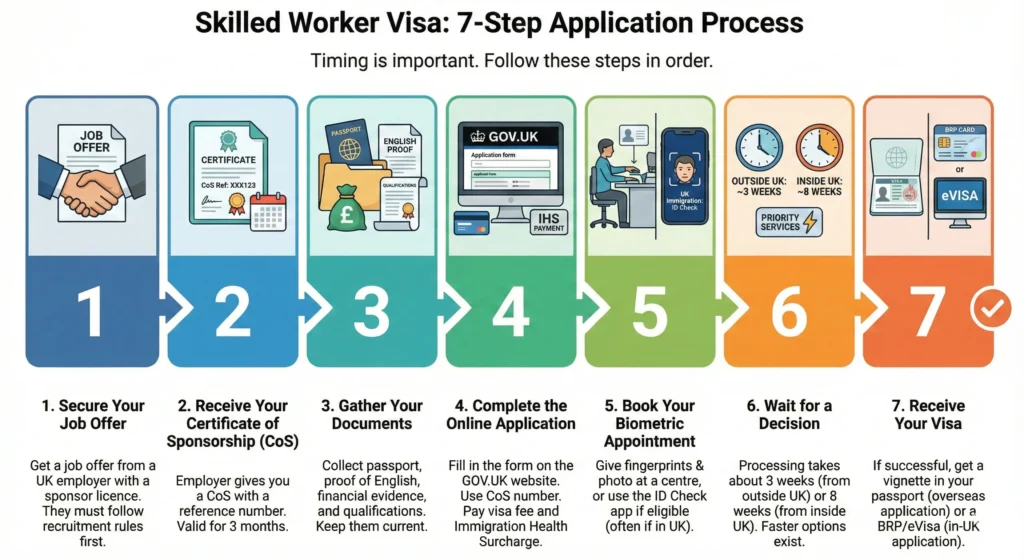
Planning a move to the UK? Don’t just pack your bags hoping for the best. This step-by-step process is a marathon, not a sprint, and you need to be prepared.
The CoS: Your Golden Ticket… with an Expiry Date
It all kicks off with that job offer. Then your employer will assign your Certificate of Sponsorship (CoS) through their rather mysterious sponsor management system. Each CoS costs £239 (a bit less for smaller companies). It’ll list all the important details: job, salary, occupation code – everything about you. Crucially, though, it’s only valid for three months. Miss that window, and it’s back to square one, my friend. Timing, as they say, really is everything here.
Empty Your Pockets: Submitting the Visa Application
Then it’s your turn. You’ll apply online, navigating the government’s somewhat labyrinthine website. First, the visa fee. Then, brace yourself, the Immigration Health Surcharge. The visa fee itself can range from £719 to £1,423, depending on where you’re applying from and how long you want to stay. And the Immigration Health Surcharge? This, my friend, is a bitter pill indeed. It’s £1,035 per year. Want a three-year visa? That’s £3,105, paid upfront. For a family of three, you’re looking at nearly ten grand before you’ve even stepped foot in the country. Let’s be clear: it’s not actually healthcare; it’s a tax.
Show Me Your Papers: Biometrics and Documents
Next, you’ll trek to a visa application center. There, you’ll give them your fingerprints, your photo, and show them your passport, your CoS reference, proof of your English proficiency, maybe a tuberculosis test, and a criminal record check. Oh, and don’t forget every single piece of paper proving your dependents are actually yours. No faking it!
The Waiting Game: Processing Times
Standard processing? Expect three weeks if you’re outside the UK, and about eight weeks if you’re applying from within. Got cash to burn? Priority service will set you back about £500, but they’ll get it done in five days. Super Priority? That’s about a grand for next-day service. Money talks, always has, always will.
The Immigration Health Surcharge: A Tax, Plain and Simple
Let’s be blunt: the IHS isn’t some friendly gesture. It’s a truly substantial cost, and you must be fully aware of it.
How They Bleed You Dry
Most applicants will pay this. The government calculates it by visa length, always rounded up to the nearest year. So, if your visa is for three years and two months? You’re paying for four. You pay it during the application process itself – no payment, no application. And here’s the real kicker: it’s completely non-refundable if your visa gets refused. Tough luck, right?
The “Benefits”
Sure, it gets you access to the NHS: GP appointments, hospital treatment, maternity care, just like UK residents. But prescriptions, dental work, eye care? You’ll still have to pay for those. So much for “free” healthcare, eh? And it applies to everyone – the main applicant and every single dependent. A family of three applying for a three-year visa? Say goodbye to a staggering £9,315 just for the IHS. Better start breaking out that piggy bank now.
Salary Requirements: Show Me the Money!
Alright, let’s talk brass tacks. Salary is king here; it directly impacts whether you even get a foot in the door.
The Big Number
£38,700. That’s the magic number for most. But hold on, it’s also about the “going rate” for your specific job code. So, if a software developer’s typical salary is £45,000, then that’s what you’re going to need. Don’t get caught out! The Home Office publishes incredibly detailed tables, so you absolutely must check them, cross-reference them, and frankly, live by them.
The Immigration Salary List: A Small Glimmer of Hope
Good news for some: jobs on the Immigration Salary List get a break. You’re looking at £30,960, or 80% of the going rate, whichever is higher. We’re talking nurses, paramedics, engineers, and certain teachers here. The UK needs them badly, so they’re willing to cut a slight deal. Just remember, this list is a moving target, reviewed regularly. Today’s hot job might just be tomorrow’s also-ran.
Newbies Get a Nudge
If you’re under 26, a recent graduate, or in an approved training program, you’re considered a “new entrant.” This means you get a reduced threshold: £30,960 or 70% of the going rate. It’s a small concession, I suppose, designed to give young talent a fighting chance. Don’t you dare take it for granted.
Dependents: Bringing Your Entourage
Family reunion. Sounds absolutely lovely, doesn’t it? Well, be warned, there are plenty of hurdles here too.
Who Gets In?
Your spouse, an unmarried partner (you’ll need to prove you’ve been together for at least two years, mind you!), and kids under 18. Sometimes, even kids over 18 if they were already here as dependents. Each and every one of them will pay their own visa fees and that truly delightful Immigration Health Surcharge. And you, as the main applicant, must prove you can support them without hitting up the public purse. Your Skilled Worker salary usually covers it, but I said usually.
What They Get
Dependent partners? They get full work rights, no restrictions whatsoever. That’s a genuine perk, actually. And the kids? They can go into UK schools, free. As long as you’re here legally, they’re here. But if your visa goes belly-up for any reason? They’re likely packing their bags right along with you.
The Long Game: Indefinite Leave to Remain
Thinking long-term? Dreaming of staying forever? Well, Indefinite Leave to Remain, or ILR, is your golden goose.
Earning Your Stay
After five years of continuous residence, Skilled Worker visa holders can finally apply for ILR. This means permanent residence – no more time limits, no more visa headaches. But you have to earn it. No single absence over 180 days in any 12-month period. You’ll still need to be in a skilled job, earning decent money. And, of course, you’ll have to pass the Life in the UK test (a laughably bizarre exam, frankly), prove your English language skills at B1, and not be a threat to national security. Not too much to ask, eh?
Counting the Days
Now, time spent on some other visas might count towards those five years. Student visas? Generally no, unless you’re a PhD. But Skilled Worker time, old Tier 2 time, and other work visas? Usually, yes. Visitor time? Forget about it. Don’t mess this up; track your dates with an eagle eye. One wrong move, and the clock resets to zero.
The Final Prize: British Citizenship
Got your ILR? Waited another 12 months? Congratulations, you can now go for British citizenship. This means full rights: vote, a UK passport, and immunity from future immigration control. The whole nine yards. If you make it this far, you’ve truly jumped through every single hoop they could throw at you.
Sector-Specific Shenanigans
Different industries, different rules, my friend. So, pay very close attention.
Healthcare and Social Care: The Desperate Ones
The NHS. They need you. Badly. That’s why healthcare workers get a crucial break via the Health and Care Worker visa. Think cheaper fees and, crucially, an exemption from that ghastly Immigration Health Surcharge. We’re talking thousands saved! Doctors, nurses, paramedics, social care workers – if you’re in this lot, you’re pretty much golden.
Technology and IT: The Rich Kids
Tech. London, and other major hubs. High salaries are the norm here, making it easy-peasy to meet those thresholds. Software developers, cyber specialists, data scientists – the red carpet is practically rolled out for these guys. Plus, there are new visas like High Potential Individual and Global Talent for the truly exceptional. Money talks, remember? Always has, always will.
Education and Academia: The Brainy Bunch
Universities? They know the drill. They’re experienced sponsors, and academics usually fit the bill without much fuss. Teachers? Only if you’re teaching science, maths, or languages, because they’re critically short in those areas. Otherwise, well, excellent luck with that.
Finance and Professional Services: The Big Spenders
London is the financial heart, and it’s always hungry for international professionals. Banking, accounting, legal, consulting – salaries are usually through the roof in these sectors, so sponsorship really isn’t an issue. These big firms often have entire teams dedicated to handling your visa, so you’re in good hands.
Brexit’s Ugly Truth: What Changed for EU Nationals
Alright, this is the big one. If you’re an EU national, or just keeping up with changes, pay very close attention.
Free Movement: Just a Memory
EU, EEA, and Swiss nationals who were already here before December 31, 2020? They had a golden opportunity to get settled status. Most of that closed in June 2021, however. If you arrived after January 1, 2021, guess what? You’re just like everyone else. No preferential treatment whatsoever. Your EU passport? Sure, it’s a nice travel document, but it won’t get you a job here anymore.
The Irish Anomaly
Irish citizens, however, are the exception that proves the rule, I suppose. They still enjoy special status under the Common Travel Area. They can live and work here, no questions asked. And it works vice-versa for Brits in Ireland. Go figure, eh?
The Labor Market: A Bit of a Mess
Brexit undeniably blew holes in some sectors that heavily relied on EU workers: hospitality, farming, construction. Sure, that’s created challenges for some bosses. But it also threw open opportunities for non-EU nationals. Now, they say, you’re all on the same level playing field. We’ll just have to see how long that lasts.
The Full Financial Picture: Brace Yourself
Don’t say I didn’t warn you. The costs involved in this whole process are, frankly, astronomical.
Application Fees
A Skilled Worker visa for three years, applying from outside the UK, will set you back £719. Five years? That jumps to £1,423. Already here and looking for an extension? It’s £827 for three years, £1,500 for five. And here’s the kicker: each dependent pays the same fees. So, for a family of four applying for a three-year visa from outside the UK? That’s £2,876 just in visa fees. And remember, that’s all before we even get to the Immigration Health Surcharge!
Things You Should Know About Visa Sponsorship in the United States Under the Trump Administration
Things U Should Know About Child Labour in 2026
Things U Should Know before travelling to the United Kingdom in 2026




Post Comment